Listening to Nothing: What the Universe's Radio Silence Is Actually Telling Us
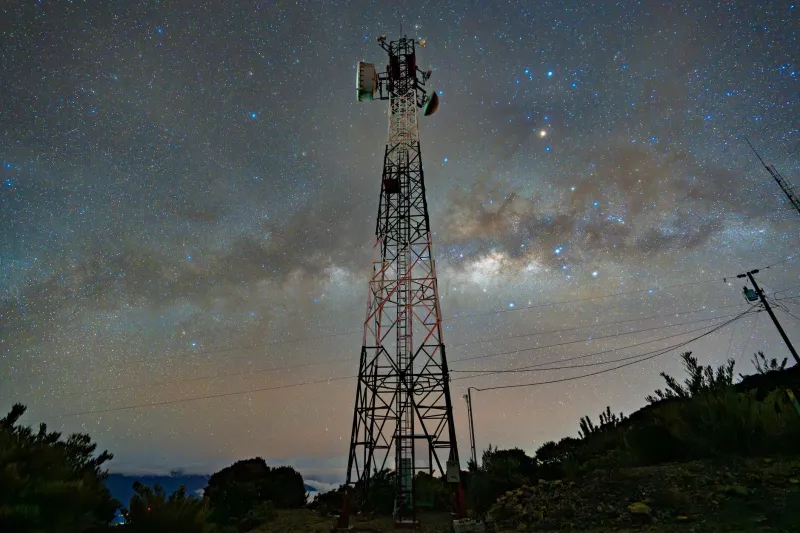
There's something quietly unsettling about pointing the most sensitive antennas humanity has ever built toward billions of stars and hearing... nothing. Not static, not interference, not even a suspicious blip that turns out to be a pulsar playing tricks. Just the deep, indifferent hum of a cosmos that doesn't seem to be calling back.
SETI — the Search for Extraterrestrial Intelligence — has been at this for over 60 years. Researchers have scanned radio frequencies, optical wavelengths, and increasingly exotic corners of the electromagnetic spectrum. The math keeps telling us there should be someone out there. The universe keeps disagreeing. And the question that's starting to eat at the field isn't just "where is everyone?" — it's "what if they're hiding?"
The Signal We Thought We'd Already Found
Back in 1977, astronomer Jerry Ehman circled a printout from Ohio State's Big Ear radio telescope and wrote one word in the margin: "Wow!" The signal lasted 72 seconds, matched almost perfectly with what a transmission from deep space might look like, and has never been detected again. For a lot of people, that was supposed to be the beginning of a story. Instead, it might be the whole story — a one-off anomaly that's spent five decades being both the best evidence we have and a reminder of how little we actually have.
Since then, the tools have gotten dramatically better. The Allen Telescope Array, Breakthrough Listen, and now next-generation facilities like the Square Kilometre Array (SKA) — which will be the largest radio observatory ever constructed — have expanded our search capacity by orders of magnitude. If a civilization somewhere in the Milky Way were broadcasting something like our own TV and radio signals, we'd theoretically have a shot at catching it within a few hundred light-years. Yet the cosmic switchboard remains stubbornly dark.
Maybe They've Gone Dark on Purpose
Here's where things get genuinely weird. One increasingly popular hypothesis among astrobiologists and SETI researchers is that advanced civilizations don't go more detectable as they develop — they go less detectable. Think about the trajectory of human communication technology. We went from high-powered AM radio towers blasting signals in every direction to fiber optic cables, encrypted data streams, and increasingly tight-beam transmissions. We're already getting quieter, and we're only a few centuries into the industrial age.
An alien civilization even a few thousand years ahead of us — a blink in cosmic time — might have shifted entirely to communication methods that look like background noise to us. Compressed, encrypted, or transmitted through mediums we haven't figured out how to monitor yet. Gravitational waves, neutrino beams, quantum entanglement networks — these aren't science fiction anymore, they're active areas of research. If an advanced civilization cracked any of these as communication channels, we'd have no idea they were talking.
There's also the darker possibility that some civilizations go quiet deliberately. The "Dark Forest" theory, popularized by Chinese science fiction author Liu Cixin, suggests that any sufficiently advanced civilization would recognize that broadcasting your location in a universe of unknown threats is just bad strategy. You don't shout in a dark forest. You listen.
What We're Actually Looking For Now
The SETI field has been quietly expanding its definition of what counts as a technosignature — evidence of technology, not just deliberate signals. This is a meaningful shift. Instead of waiting for someone to call us, researchers are looking for the exhaust fumes of civilization: things like atmospheric chemical imbalances that suggest industrial activity, artificial light patterns on planetary surfaces, megastructures like Dyson spheres that might partially occlude a star's light, or even the heat signatures of energy-hungry civilizations bleeding infrared radiation into space.
The 2015 dimming anomaly around Tabby's Star (officially KIC 8462852) sent the internet into a brief, glorious frenzy of Dyson sphere speculation before more mundane explanations — clouds of dust, most likely — started gaining ground. But the fact that the conversation happened at all reflects how seriously researchers are taking non-traditional detection methods. Breakthrough Listen's latest surveys are now incorporating machine learning to sift through petabytes of radio data for patterns that human analysts would miss. It's not glamorous work, but it's the kind of methodical, unglamorous work that tends to actually find things.
The Mirror Problem
Here's the part that should probably make us a little uncomfortable. The silence isn't just a mystery about them — it's a data point about us. If technological advancement tends to make civilizations quieter, more efficient, and less electromagnetically leaky over time, then humanity's current phase — loud, sprawling, broadcasting reality TV into the void — might be a brief, transitional window. A blip.
And if civilizations tend to either go quiet voluntarily or go quiet because something ends them, then the Fermi Paradox stops being just an astronomy puzzle and starts being a survival question. Are we in a race against our own tendency toward catastrophic self-interference — climate collapse, engineered pandemics, nuclear miscalculation — before we reach the kind of long-term stability that would let us be the civilization that other civilizations eventually find?
Some researchers, like those affiliated with the Future of Humanity Institute before its closure, argued that the Great Filter — whatever culls civilizations before they become galaxy-spanning — might still be ahead of us rather than behind us. That's not a comfortable thought to sit with on a Tuesday morning, but it's a serious scientific hypothesis.
Silence as Data
The temptation is to treat the absence of a signal as a failure — 60-plus years of effort with nothing to show for it. But that's the wrong frame. Every null result is information. Every frequency we've scanned without finding a coherent signal tells us something real about the distribution of technological life in our cosmic neighborhood. The silence is a measurement. It's just not the measurement anyone was hoping for.
What it might ultimately be telling us is that the universe is under no obligation to communicate in ways we recognize. That intelligence — wherever it exists — doesn't necessarily look like us, think like us, or want the same things we want. And that the search itself, the act of building bigger ears and pointing them at the sky with genuine curiosity and scientific rigor, might be one of the most distinctly human things we've ever done.
We're still listening. The universe is still quiet. And somehow, that tension feels like exactly the right place to be.