Dead Air: How We're Reinventing the Rules of Talking Across the Galaxy
Imagine sending a text message and waiting two days for a reply. Now imagine that's the best-case scenario — and that by the time your message arrives, the situation you were asking about has already resolved itself, for better or worse, without you. That's the daily reality of deep space communication, and it's about to become a much bigger problem as humanity sets its sights beyond Mars.
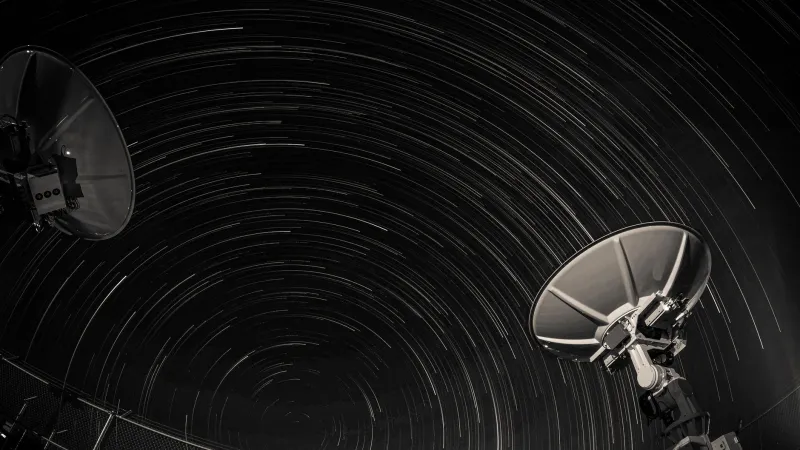
Right now, NASA's Deep Space Network — a collection of massive dish antennas in California, Spain, and Australia — handles most of our interplanetary chatter. It's an impressive piece of infrastructure, but it was designed for a solar system-scale conversation. The moment we start seriously talking about probes headed for Alpha Centauri or even the outer edges of the heliosphere, the whole framework starts to crack.
So what happens when the silence between messages isn't an inconvenience, but a fundamental condition of exploration itself?
The Speed of Light Is Not Your Friend
Here's the brutal physics of it: nothing travels faster than light, and light is slower than it sounds when you're talking about real cosmic distances. A signal to Mars takes anywhere from 3 to 22 minutes one way, depending on where both planets are in their orbits. To Jupiter, you're looking at 35 to 52 minutes. Neptune? Over four hours each way.
Now stretch that out to interstellar scales. The nearest star system, Alpha Centauri, sits about 4.37 light-years away. A message sent today wouldn't arrive for over four years. A reply — assuming anything's there to send one — wouldn't come back for another four. That's not a communication delay. That's a generational gap.
This is what researchers sometimes call the latency wall, and it doesn't just complicate mission control logistics. It fundamentally changes what exploration means. You can't supervise something you can't talk to in real time. Which means the spacecraft — or the crew, if we ever get that far — has to be capable of making its own calls.
Autonomy Isn't Optional Anymore
The most immediate response to the latency wall isn't exotic physics — it's software. Space agencies and private contractors are pouring serious resources into autonomous decision-making systems that can let a probe or rover handle unexpected situations without phoning home first.
NASA's current Mars rovers already carry versions of this. Perseverance, for example, uses onboard hazard detection to navigate terrain without waiting for instructions from Earth. But that's a relatively simple problem compared to what a truly autonomous deep space probe would need to manage — equipment failures, unexpected scientific discoveries, navigation corrections, and potentially thousands of micro-decisions over a mission that lasts decades.
The goal is something engineers call "graceful autonomy" — systems that can operate independently while still aligning with the original mission intent, even when circumstances drift far from what anyone planned for back on Earth. Think of it less like remote control and more like sending a very well-briefed astronaut who you'll never be able to call.
Some researchers are drawing inspiration from biological systems — specifically, the way organisms make decisions under uncertainty without a central command structure. Swarm intelligence models, borrowed from studying ant colonies and bird murmurations, are being tested as frameworks for coordinating multiple autonomous probes that need to work together without a human referee.
Laser Links and Optical Frontiers
On the hardware side, one of the most promising near-term upgrades to deep space communication is laser-based optical transmission. Traditional radio waves spread out as they travel, losing signal strength over distance. Lasers stay tighter, meaning you can pack more data into the same beam over far greater distances.
NASA's Deep Space Optical Communications experiment, which hitched a ride on the Psyche mission, is already testing this in practice. Early results have been encouraging — the technology demonstrated data rates that would've seemed like science fiction just a decade ago at comparable distances.
But optical communication has its own headaches. Pointing a laser precisely enough to hit a receiver millions of miles away requires extraordinary precision. And unlike radio, lasers don't punch through clouds, which means ground-based receivers need either ideal weather conditions or space-based relay stations. Neither is cheap.
The longer-term vision involves a kind of interplanetary internet — a mesh of relay satellites and deep space waypoints that can route signals the way the terrestrial internet routes data packets, finding the best available path rather than depending on a single direct line.
The Quantum Wildcard
No conversation about future communication tech is complete without the quantum entanglement question, so let's address it directly: no, quantum entanglement cannot transmit information faster than light. This is a common misconception, and it's worth squashing.
What entanglement can potentially offer is something different but still valuable — ultra-secure communication channels that are theoretically impossible to intercept without detection. Quantum key distribution, already being tested in terrestrial and low-Earth-orbit applications, could eventually provide a layer of cryptographic security for deep space transmissions that no classical system can match.
Beyond security, some physicists are exploring whether quantum systems could play a role in more efficient data compression or error correction over extreme distances. It's speculative territory, but the research is real and ongoing.
The honest answer is that quantum communication is unlikely to solve the latency problem — but it might make the messages we do send significantly harder to corrupt or compromise.
Sending Into the Void
There's a philosophical dimension to all of this that doesn't get enough airtime. When you design a communication system for interstellar distances, you're not just solving an engineering problem. You're confronting the possibility that you may never get a reply.
The Voyager probes, launched in 1977, are now so far away that their signals take over 22 hours to reach Earth. We can still hear them, barely. But a probe sent toward another star system would go dark long before it arrived — and any signal it sent back would take years to reach us. The people who launched it would likely be retired or dead before the first scientific data came home.
This changes the psychology of exploration in ways we're only beginning to reckon with. It demands a kind of institutional patience that doesn't come naturally to organizations that answer to annual budgets and four-year election cycles. It also raises a quieter question: what does it mean to explore somewhere you'll never truly know you've reached?
Some researchers argue this is actually clarifying. Strip away the expectation of real-time feedback, and you're forced to design missions that are complete in themselves — probes that can make meaningful observations and decisions regardless of whether anyone's listening. That's a different philosophy of exploration than the one we've been running on.
The Long Conversation
The silence doctrine, as some in the field informally call it, isn't about giving up on communication. It's about redesigning what communication means when the rules of physics won't bend to meet our expectations.
Lasers, autonomous systems, quantum-secured channels, relay networks — none of these are silver bullets. Each solves part of the problem while introducing new constraints. The real breakthrough might not be a single technology but a new operating philosophy: one that accepts delay as a feature rather than a bug, and builds missions robust enough to speak for themselves even when no one's on the other end of the line.
We've always been a species that shouts into the dark and hopes something shouts back. The difference now is we're starting to design for the possibility that the echo takes a very, very long time — and we need to be ready to keep going anyway.