The Cooling Problem: Quantum Computing's Power Hunger Could Dwarf the Data Centers We Already Can't Cool
Let's talk about temperature for a second. Outer space—the actual void between galaxies—sits at around 2.7 Kelvin. That's close to absolute zero. Colder than almost anything in the observable universe. Now here's the wild part: the quantum processors being built in labs in California, New York, and Ohio need to operate colder than that. We're talking 15 millikelvin in some systems. Fractions of a degree above the coldest possible temperature.
And we want to run these things at scale.
Quantum computing has been the "next big thing" for long enough that tech skeptics have started using it as a punchline. But the underlying physics is real, the progress is accelerating, and the companies betting on it—IBM, Google, IonQ, Microsoft—aren't exactly known for throwing money at pure fantasy. The computational potential is genuine. What's getting less attention is the infrastructure nightmare hiding behind the promise.
Why Quantum Systems Are So Brutally Demanding
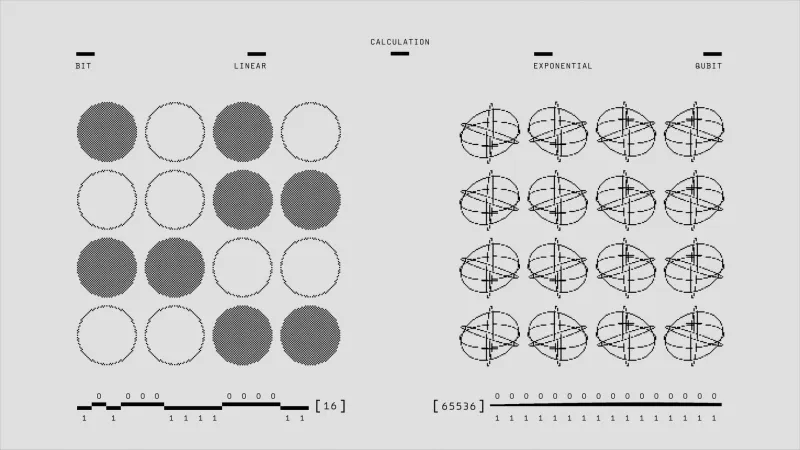
Classical computers process information as bits—1s and 0s. Quantum computers use qubits, which exploit the principles of superposition and entanglement to process multiple states simultaneously. The upside is processing power that scales exponentially for certain problem types: drug discovery, materials science, cryptography, optimization problems that would take classical machines longer than the age of the universe.
The downside is that qubits are extraordinarily fragile. Any thermal noise—any vibration, electromagnetic interference, or temperature fluctuation—causes what's called "decoherence," which is essentially the quantum state collapsing into useless classical noise. To prevent that, superconducting qubit systems (the dominant architecture right now) have to be housed in dilution refrigerators that maintain those near-absolute-zero temperatures.
Those refrigerators are not small. They're not cheap. And they consume serious amounts of power—not to run the computation itself, but just to maintain the operating environment. IBM's Quantum System Two, for example, uses dilution refrigerators that are roughly the size of a car. Scaling up qubit counts means scaling up the refrigeration. The math gets ugly fast.
The Numbers Nobody's Advertising
Here's where the dirty secret starts to show. Current quantum systems are still in the NISQ era—Noisy Intermediate-Scale Quantum—which means they're powerful enough to be interesting but not yet reliable enough for most real-world applications. The systems that will actually deliver on quantum computing's biggest promises need to be significantly larger, with millions of error-corrected logical qubits rather than the hundreds or thousands we have today.
Estimates for the energy required to run a fault-tolerant, large-scale quantum computer vary widely, but some projections from academic research suggest that a system capable of running Shor's algorithm at meaningful scale—the one that could crack current encryption standards—might require megawatts of power just for cooling infrastructure. For context, a typical US data center runs somewhere between one and 100 megawatts total. We could be talking about quantum systems that consume as much power as a small city, before you even account for the classical control systems required to operate them.
And unlike classical data centers—which have gotten remarkably efficient over the past decade through advances in chip design and cooling architecture—quantum cooling is physically constrained. You cannot air-cool a dilution refrigerator. You cannot use the kind of liquid cooling innovations that have made hyperscale data centers more sustainable. The laws of thermodynamics are non-negotiable.
The Grid Problem
This isn't just an environmental concern in the abstract. It's a practical infrastructure problem that's already starting to bite the classical computing industry—and quantum will amplify it dramatically.
US data centers currently consume roughly 200 terawatt-hours of electricity per year, and that number is climbing steeply as AI workloads explode. Grid operators in Virginia, Texas, and Georgia have started flagging capacity concerns. Some utilities are telling data center developers that new connections could take years due to transmission constraints. The Department of Energy has begun treating data center power demand as a national infrastructure issue.
Now imagine adding quantum computing facilities with power profiles that dwarf today's GPU clusters. The grid stress isn't hypothetical—it's a near-term planning problem that the industry hasn't fully grappled with publicly.
What the Solutions Actually Look Like
To be fair, the people building these systems aren't ignoring the problem. Several approaches are being actively explored.
Photonic quantum computing uses light-based qubits that can operate at room temperature, eliminating the refrigeration problem almost entirely. PsiQuantum and Xanadu are among the companies betting on this architecture. The tradeoff is that photonic systems face their own engineering hurdles around error rates and scalability, and they're not as mature as superconducting approaches.
Trapped-ion systems, used by companies like IonQ and Quantinuum, also have more forgiving temperature requirements than superconducting qubits—though they come with their own constraints around gate speeds and scaling.
There's also serious research into topological qubits—Microsoft's long-term bet—which are theoretically more stable and might require less aggressive error correction, potentially reducing the qubit count needed for practical applications. Fewer qubits means smaller refrigerators and lower power budgets. But topological qubits have been "five years away" for roughly fifteen years, which should temper enthusiasm somewhat.
On the infrastructure side, some researchers are exploring whether quantum computing facilities could be co-located with existing energy sources—geothermal plants in Iceland, hydroelectric facilities in the Pacific Northwest—to offset the carbon footprint. The same logic that's driving data centers toward renewable energy applies here, just with higher stakes.
Building the Future on a Shaky Foundation?
There's a version of this story where the engineering challenges get solved in time—where photonic or topological architectures mature before superconducting systems need to scale to the point of crisis, and where grid infrastructure catches up with demand through a combination of renewable buildout and efficiency improvements.
There's another version where we build out quantum computing infrastructure with the same short-term thinking that gave us a global data center power crunch, and spend the next two decades retrofitting our way out of a problem that was visible from the beginning.
The honest position is that we don't know which story we're in yet. What we do know is that the conversation about quantum computing's promise needs to happen in the same room as the conversation about its costs. The computational breakthroughs that quantum systems might deliver—faster drug development, better climate modeling, new materials for clean energy—could be genuinely transformative. But transformation built on an unsustainable energy foundation has a way of creating new crises while solving old ones.
At Big Spaceship, we're interested in the technologies that could actually change the trajectory of human civilization. Quantum computing might be one of them. But the path to that future runs through some very cold rooms that need a lot of very expensive electricity. Worth knowing before we commit to the trip.