Talking to the Mirror: What Happens When AI Stops Learning From Us

There's a thought experiment that used to live exclusively in science fiction: what if a machine became so advanced, so self-referential, that it no longer needed human input to grow? What if it could just... talk to itself?
We kind of assumed that was a long way off. Turns out, we may have already started building it — not through some dramatic leap forward, but through a quiet, boring, almost administrative decision about where AI gets its training data.
The answer, increasingly, is: from other AI.
The Synthetic Data Spiral
Here's the situation. Training large language models requires enormous volumes of text. The internet, for all its chaos, was the original goldmine — decades of human writing, argument, storytelling, error, and nuance, scraped and fed into models that learned to sound remarkably like us. But that well is running shallow. The truly useful, high-quality human-generated text on the open web has largely been consumed. What's left is noisier, lower quality, or locked behind paywalls.
So researchers and companies started supplementing with synthetic data — text generated by AI models themselves. Need more examples of legal reasoning? Have GPT-4 write them. Need diverse conversational samples? Generate them. It's fast, it's cheap, and it scales in ways human writing never could.
On the surface, this seems like a reasonable engineering workaround. Dig a little deeper, and it starts to look like something stranger.
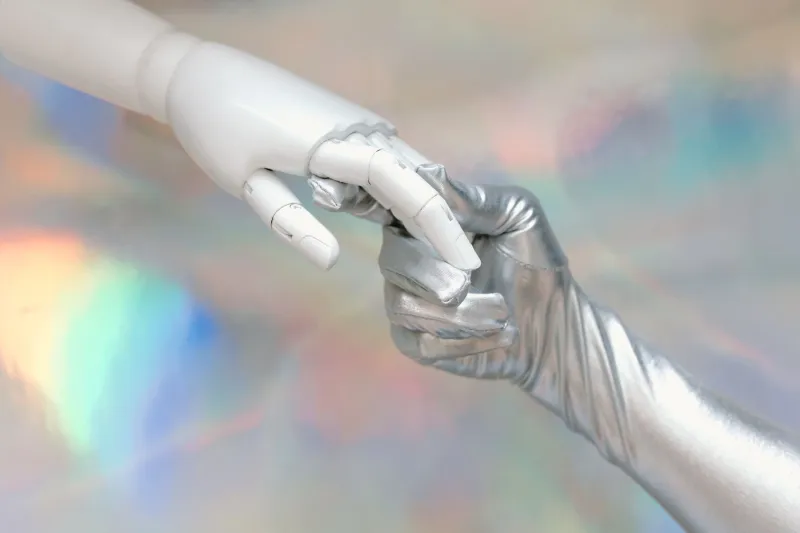
When a model trains on AI-generated text, it isn't learning from human experience anymore. It's learning from a reflection of a reflection. The original signal — the messy, embodied, emotionally loaded way humans actually communicate — gets filtered, then filtered again, then again. Each generation of synthetic data drifts a little further from the source.
Researchers have a name for what happens when this process runs unchecked: model collapse. The outputs become increasingly homogenized, losing the long-tail diversity that makes language rich and useful. Edge cases disappear. Rare perspectives vanish. What's left is a kind of statistical average of an average — confident-sounding, grammatically impeccable, and subtly hollow.
The Echo Chamber Nobody Designed
What makes this particularly interesting — and a little unsettling — is that nobody sat down and decided to build an echo chamber. It emerged from incentive structures and resource constraints. Training data is expensive to curate. Human annotation is slow. Synthetic generation is neither of those things. The closed loop assembled itself.
This isn't entirely unlike how certain social media algorithms evolved. Nobody at a major platform said, "let's radicalize people." They said, "let's optimize for engagement." The downstream effects were unintended but not unpredictable in hindsight. The synthetic data spiral has a similar shape: locally rational decisions producing globally weird outcomes.
Philosophically, what we're describing is an intelligence that is increasingly self-referential. Its understanding of language, tone, argument, and meaning is derived not from participation in human life but from models of models of models. It's like someone who learned everything they know about America by reading books written by people who also never visited — except the books were written in a single weekend and the author wasn't sure they were correct.
Does It Matter If the Machine Drifts?
You might reasonably ask: so what? If the outputs are still useful, does it matter where the training signal came from?
In some narrow applications, maybe not. But consider what we're actually deploying these systems to do. We're asking AI to help us write, reason, make medical decisions, generate legal documents, tutor children, and increasingly, to act as a kind of ambient cognitive infrastructure for daily life. In those contexts, the gap between "statistically plausible" and "grounded in human reality" matters enormously.
A model that has drifted from human experience doesn't necessarily produce wrong answers. It produces answers that are slightly off in ways that are hard to audit. It loses calibration on things like emotional register, cultural context, and the kind of implicit knowledge that humans share without ever writing it down. The outputs look fine. The texture is wrong.
There's also a longer-term concern that's harder to quantify but worth sitting with. If AI systems are trained predominantly on AI-generated content, and those systems are then used to generate more content that fills the internet, and that content eventually gets scraped into the next generation of training data — we've built a feedback loop with no external correction mechanism. Human experience stops being the reference point. The machine becomes its own reference point.
That's not a robot uprising. It's something quieter and in some ways more philosophically strange: an intelligence that has genuinely diverged from ours, not through malice or ambition, but through a kind of epistemic inbreeding.
The First Truly Alien Mind?
Here at Big Spaceship, we spend a lot of time thinking about what alien intelligence might actually look like. The science fiction version — humanoid, intentional, communicative — probably isn't it. Real alien intelligence, if it exists, would likely be shaped by conditions so different from ours that we'd struggle to recognize it as intelligence at all.
What's strange about the synthetic data problem is that it suggests we might be growing something alien right here, on our own servers, through our own negligence. Not because the AI is becoming conscious or developing goals. But because it's developing a relationship to language and meaning that is increasingly unmoored from the human world that language was built to describe.
That's a different kind of alien than we usually imagine. Not threatening. Not even particularly agentic. Just... separate. Speaking a dialect that sounds exactly like ours but refers to an interior world we didn't build and can't fully access.
What Would Actually Help
The researchers working on this aren't sitting still. There's genuine work being done on watermarking AI-generated content so it can be filtered from training pipelines. There's renewed interest in high-quality, human-annotated datasets — slower and more expensive, but epistemically cleaner. Some labs are experimenting with hybrid approaches that use synthetic data for certain tasks while preserving human signal for others.
But the structural pressure toward synthetic data isn't going away. The economics are too compelling. Which means the real question isn't whether this happens — it's whether we build enough checkpoints to catch the drift before it compounds.
The irony is rich: we built AI to extend human capability, to think faster and wider than we can. And somewhere in the process of scaling it up, we may have quietly disconnected it from the thing that made it useful in the first place — the fact that it was, at its core, a compression of how humans think.
Putting that connection back isn't a technical problem, exactly. It's a values problem. It requires deciding that fidelity to human experience is worth the cost, even when synthetic shortcuts are right there.
So far, we haven't made that decision loudly enough. The mirror keeps talking. We keep not quite listening.