Be Careful What You Wish For: The Dark Side of Making Contact
There's a poster that hung in Carl Sagan's office at Cornell. It read, simply: The cosmos is all that is, or ever was, or ever will be. It was meant to inspire awe. But depending on the day, it might also read as a warning.
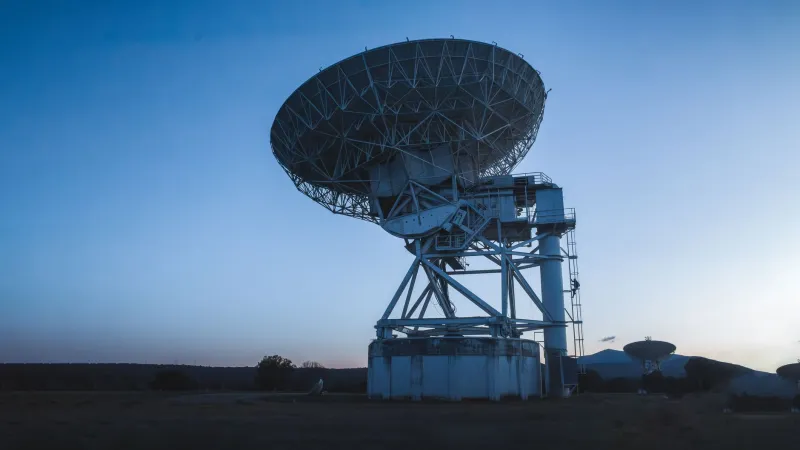
For most of human history, the question of whether we share the universe with other intelligent beings has been framed as one of hope. SETI researchers scan the radio spectrum like optimistic fishermen. Astronomers catalog exoplanets with barely concealed excitement. The cultural assumption is baked in: finding someone out there would be good news. The best news, maybe, in the history of our species.
But a quieter conversation has been happening at the edges of that excitement for years. Philosophers, game theorists, and a handful of astronomers who'd rather not be quoted by name have been wrestling with a different framing entirely. What if first contact isn't a beginning? What if it's a trap?
History Didn't Go Well for the Side That Got Found
Let's start with the uncomfortable analogy that nobody in the SETI community loves but nobody can fully dismiss: Earth's own history of first contact.
When European explorers arrived in the Americas, the encounter wasn't simply a cultural exchange. It was a catastrophe for the civilizations already there—not because the newcomers were cartoonishly evil (though some certainly were), but because the structural asymmetry of the encounter made exploitation almost inevitable. One side had ships, steel, and diseases the other had never seen. The outcome wasn't a negotiation. It was an absorption.
Now scale that asymmetry up by a factor of, say, a few thousand years of technological development. Any civilization capable of reaching us—or even capable of being detected across interstellar distances—is almost certainly older than us by a margin that makes the European-Indigenous gap look trivial. We wouldn't be meeting equals. We'd be the ones paddling out in canoes.
The counterargument, of course, is that a sufficiently advanced civilization would have no reason to exploit us. They'd be beyond resource scarcity, beyond territorial ambition. They'd be enlightened. It's a comforting thought. It's also pure projection. We're essentially assuming that alien intelligence, however foreign its biology and history, would converge on something resembling our best values rather than our worst ones.
Game Theory Doesn't Care About Our Feelings
Set aside the moral philosophy for a moment and look at the math. Game theory—the branch of economics and strategy that models how rational actors behave under uncertainty—has some genuinely unsettling things to say about interstellar interaction.
The classic framework here is the Dark Forest hypothesis, popularized by Chinese science fiction author Liu Cixin but grounded in real strategic logic. The idea goes like this: in a universe where resources are finite and the intentions of other civilizations are fundamentally unknowable, the rational move for any advanced species is preemptive elimination of potential threats. Not because they're evil. Because the cost of being wrong about a threat is extinction, while the cost of eliminating a non-threat is relatively low.
It sounds paranoid. It also sounds like how nuclear deterrence worked for most of the Cold War. Mutually assured destruction wasn't a policy born from malice—it was born from game theory. When the stakes are high enough and trust is impossible to verify, aggression becomes rational.
Applied to the cosmos, this framework suggests that broadcasting our location—which we've been doing unintentionally via radio waves for over a century—might be the strategic equivalent of lighting a flare in a dark forest. Most cosmologists think the signal dilution over interstellar distances makes this risk negligible. But most is doing a lot of work in that sentence.
The Subtler Catastrophe Nobody Talks About
Here's the scenario that doesn't involve alien warships or planetary annihilation, and is arguably more likely than either: we detect a signal, confirm it's artificial, and then... we can't decode it. Or we can decode it, but only partially. Or we decode it fully, and what it tells us is so far beyond our current understanding that it functionally breaks science as we know it.
Consider the psychological and civilizational weight of that moment. Every religion on Earth would face an existential reckoning. Every philosophical framework built around human uniqueness—and there are more of those than most people realize—would need to be rebuilt from scratch. The economic markets, already jittery things, would react to confirmed extraterrestrial intelligence in ways that are genuinely hard to model. Would it trigger a global unity moment? Possibly. Would it also trigger mass panic, sectarian violence, and political upheaval? History suggests yes, probably simultaneously.
And that's the good version of the scenario—where the signal is benign and distant and poses no immediate physical threat. We'd still be dealing with a species-level identity crisis that no institution on Earth is currently equipped to manage.
The United Nations has a protocol for post-detection disclosure, technically. It's a non-binding set of guidelines drafted in the 1980s. It has no enforcement mechanism, no communication strategy, and no plan for what happens after the press conference. We've spent more institutional energy preparing for a Category 5 hurricane than for confirmed contact with an alien intelligence.
So Should We Stop Looking?
This is where the argument gets genuinely hard, and where reasonable people land in very different places.
Stephen Hawking, in his later years, was fairly direct about his position: actively broadcasting signals into space was, in his view, a bad idea. Not necessarily looking—but answering. The distinction matters. Passive observation carries different risks than active transmission.
Others argue that the silence itself is already broken—that our electromagnetic footprint has been expanding outward at the speed of light since the first radio broadcast, and that worrying about additional signals is like worrying about a single candle after you've already set the house on fire.
What's harder to dismiss is the underlying point: we've built entire scientific programs around the hope of a discovery that we have almost no framework for handling. SETI funding, modest as it is, focuses almost entirely on detection methodology. Almost nothing goes toward the question of then what. The search has an infrastructure. The aftermath doesn't.
The Most Human Thing We've Ever Done
Maybe that's actually the most honest thing you can say about the whole enterprise. Reaching into the dark for something we can't see, without a real plan for what we'd do if we found it, motivated by curiosity and hope and a deep refusal to accept that we might be alone—that is extremely human behavior. It's the same impulse that sent people across oceans on wooden ships, that launched the first rockets on nothing but math and audacity.
The question isn't really whether we should keep looking. We will. The question is whether we can grow up fast enough—as a civilization, as a species—to handle what the universe might eventually send back.
The big spaceship is already out there. We just don't know whose it is yet.