Shouting Into the Void and Whispering at the Same Time: The Strange Paradox of Our Cosmic Footprint
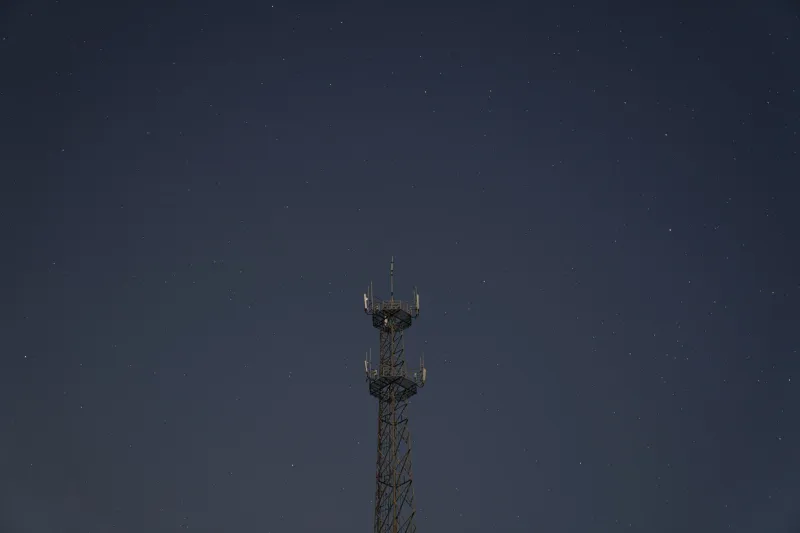
Here's a thought experiment worth sitting with for a minute. Imagine you're a highly advanced civilization somewhere in the Milky Way, pointing your best radio telescope at a small blue planet orbiting a yellow star. A hundred years ago, you would have heard it coming from light-years away — a chaotic, gloriously messy wash of AM radio waves, analog TV signals, military radar pulses, all bleeding freely into space like a cosmic jukebox left on full blast. That planet was loud. You'd know someone was home.
Now fast-forward to today. That same planet has launched thousands of satellites, built out global 5G networks, and sent probes hurtling toward the edges of the solar system. By almost any measure, it's more technologically sophisticated than ever. And yet, if you were that alien astronomer? You might think the lights went out.
Welcome to one of the strangest contradictions in the modern search for extraterrestrial intelligence.
The Analog Era Was Accidentally Our Best PR Campaign
For most of the 20th century, Earth was, unintentionally, a pretty easy planet to find. Analog broadcast signals — AM and FM radio, VHF and UHF television — are inefficient by design. They bleed power. They spread wide. And crucially, they leak into space in ways that carry recognizable structure: repeating patterns, carrier waves, the kind of organized electromagnetic noise that screams intelligent origin to anyone listening.
The classic example most people cite is the "television bubble" — a roughly 100-light-year sphere of Earth's broadcast history expanding outward at the speed of light. Somewhere out there, in theory, the first episodes of I Love Lucy are still traveling through interstellar space. It's a romantic idea. It's also, increasingly, a historical footnote.
Because starting in the late 1990s and accelerating sharply through the 2000s and 2010s, we started switching everything over to digital. Cable replaced over-the-air TV. Streaming gutted broadcast radio. Cell towers replaced shortwave. And digital signals, by their very nature, are compressed, encrypted, and tightly directed. They carry more information in less bandwidth, waste almost no power on unintended recipients, and look — from the outside — almost indistinguishable from random noise.
5G, Starlink, and the Art of Disappearing
The rollout of 5G across the United States and globally is a useful case study. These networks operate at higher frequencies, use beamforming technology to direct signals precisely where they need to go, and are engineered specifically to minimize interference and leakage. That's great for your download speeds. It's terrible for your detectability from Alpha Centauri.
Starlink and its competitors are adding another layer to this. SpaceX now operates over 6,000 satellites in low Earth orbit, with plans to expand significantly. These satellites communicate with ground stations using highly focused, low-power links. From deep space, the net effect isn't a brighter Earth — it's a more diffuse, harder-to-read one. The electromagnetic signature of our civilization is getting more complex and simultaneously more compressed.
Even our deep space probes — the ones we actually intend to be heard — are increasingly narrow-band and directional. The Voyager probes, launched in the 1970s, transmit at about 23 watts. Your average kitchen light bulb puts out more power. The difference is that Voyager aims precisely at Earth. Anything not in that narrow beam gets nothing.
So Are We Actually Getting Quieter?
Not exactly — and this is where it gets genuinely complicated. Total radiated power from Earth has almost certainly increased. We have more transmitters, more devices, more infrastructure than at any point in human history. The planet's electromagnetic output, measured in raw watts, is probably higher now than it was in 1970.
But raw power isn't the same as detectability. What matters to a distant observer isn't how much energy we're putting out — it's whether that energy carries a recognizable signal above the background noise of the universe. And on that metric, we're losing ground fast.
SETI researchers have been wrestling with this problem for years. Astronomer Woodruff Sullivan and colleagues published work as far back as the 1990s noting that Earth's "radio luminosity" — the portion of our transmissions that actually escapes into space in a detectable form — was already beginning to decline relative to our total output. The trend has only steepened since.
The uncomfortable implication? If civilizations inevitably follow this technological trajectory — moving from leaky analog to tight digital as they mature — then the window during which any civilization is easily detectable from afar might be surprisingly short. Maybe a century or two. Cosmically, that's basically nothing.
The Fermi Paradox Gets a New Wrinkle
This idea slots uncomfortably into the broader Fermi Paradox conversation. One standard response to "where is everybody?" has always been: maybe we just haven't heard them yet. But if advanced civilizations naturally become electromagnetically quieter as they develop better technology, then the silence we're hearing might not mean the universe is empty. It might just mean everyone else has already gone digital.
That's either reassuring or deeply unsettling, depending on your mood. It suggests the galaxy could be crawling with intelligent life that we'd have almost no chance of detecting with our current methods — because they've long since stopped leaking the kind of radio noise we're built to find.
Some researchers have proposed that the solution is to look for different signatures entirely: laser pulses, neutrino beams, gravitational wave modulations, or even the infrared heat signatures of Dyson spheres. The argument being that if radio leakage is a temporary phase, we need detection strategies that work on civilizations that have moved past it.
What This Means for Our Own Search
There's a practical question buried in all of this that doesn't get enough attention: if we're becoming harder to detect, should we be doing more deliberate broadcasting? The concept of Active SETI — intentionally transmitting powerful, structured signals toward promising star systems — has always been controversial. Some scientists argue it's reckless to announce our location to unknown entities. Others think it's the only logical move if we actually want to make contact.
But the paradox here is sharp. The same technological progress that makes us safer, more connected, and more capable as a civilization is also, as a side effect, pulling a kind of electromagnetic cloak over our planet. We're not hiding on purpose. We're just optimizing. And optimization, it turns out, looks a lot like invisibility from a few light-years out.
Maybe that's fine. Maybe first contact was never going to happen via leaked TV signals anyway. But it does force a rethink of some of our core assumptions about how civilizations find each other across interstellar distances — and whether the universe's silence is a feature, not a bug, of how intelligent life tends to evolve.
The stars aren't answering. But it's worth asking whether, to anyone listening out there, we've already gone quiet too.