The Quieter the Universe Gets, the Louder the Questions Become
There's something deeply unsettling about getting exactly what you asked for and still coming up empty.
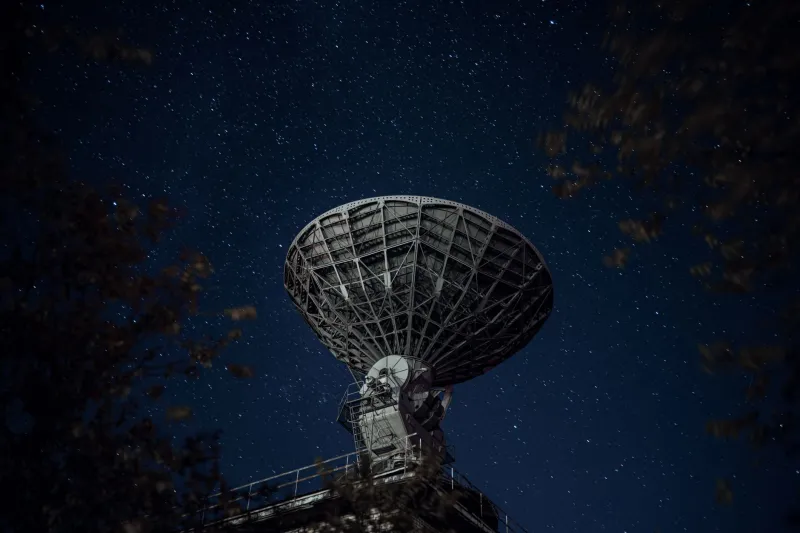
For decades, astronomers and SETI researchers pushed for better equipment — bigger dishes, more sensitive receivers, wider frequency coverage, longer observation windows. The argument was simple: we just weren't listening hard enough. Build the right tools, aim them in the right direction, and the universe would eventually answer back.
Well, we built the tools. The James Webb Space Telescope is now returning images of galaxies that formed less than 400 million years after the Big Bang. The Allen Telescope Array scans the sky continuously. Breakthrough Listen, funded with $100 million and the backing of some of the biggest names in science and tech, has surveyed more star systems in recent years than the entire previous history of SETI research combined.
And the universe? Still not talking.
More Power, Same Silence
Here's where it gets genuinely strange. As our instruments improve, the silence doesn't just persist — it deepens. Every new generation of telescope expands the volume of space we can meaningfully survey, which means every null result rules out more possibilities than the last one did.
When early radio telescopes heard nothing in the 1960s, skeptics could reasonably say we were barely scratching the surface. Fair enough. But when Breakthrough Listen surveys the galactic center and thousands of nearby star systems with modern hardware and still detects zero unambiguous technosignatures, that's a different kind of quiet. That's the universe actively declining to respond despite us essentially shouting into it with a megaphone.
Astronomers call this the Fermi Paradox, named after physicist Enrico Fermi's famous lunchtime observation that the math of a universe teeming with life should have produced detectable civilizations by now — and yet, nothing. But what often gets lost in casual discussions of the paradox is how much worse the numbers have gotten as our detection capabilities improved. We're not just failing to find signals we expected. We're failing to find signals we genuinely should be able to detect if standard assumptions about technological civilizations hold up.
The Assumption Problem
Maybe the assumptions are the issue.
Almost every SETI search in history has been built on a very specific model of what an advanced civilization looks like: it uses electromagnetic radiation to communicate, it does so in ways that leak into space, and those leaks fall within frequency ranges we consider logical to monitor. The "cosmic watering hole" hypothesis, for instance, suggests civilizations would broadcast near the 1.4 GHz hydrogen line because it's a universal landmark in the radio spectrum. Makes sense — if you think like a mid-20th-century human radio engineer.
But what if technological development doesn't converge on radio waves? What if civilizations that survive long enough eventually migrate to communication methods we haven't conceived of yet — tight-beam laser networks, quantum entanglement channels, or something so far outside our current physics that we don't even have a name for it? We'd be listening for smoke signals from a civilization that switched to fiber optic cable a million years ago.
There's also the energy question. The most commonly cited marker of a truly advanced civilization is a Dyson sphere — a megastructure that captures a star's entire energy output. We've actually looked for these, scanning for stars with anomalous infrared signatures. A handful of candidates have turned up over the years, most famously Tabby's Star, which blinked in ways that briefly sent the internet into a frenzy. Every single one has so far been explained by natural phenomena. Dust. Debris. Geometry.
The universe keeps showing us its work, and none of it involves engineers.
The Scale Problem Nobody Talks About Enough
Here's a perspective shift that tends to recalibrate things pretty quickly: the Milky Way is roughly 100,000 light-years across and contains somewhere between 100 and 400 billion stars. Breakthrough Listen, for all its impressive reach, has meaningfully surveyed maybe a few thousand of them in depth. That's not a rounding error — that's like draining one cup of water from the Pacific Ocean and concluding there are no fish.
So the silence might not mean anything yet. We might simply be at the very beginning of a search that requires centuries of sustained effort before we can draw real conclusions.
But that framing, while intellectually honest, doesn't fully resolve the discomfort. Because the Fermi Paradox isn't just about whether we've personally detected a signal. It's about why the universe doesn't appear to be visibly modified by intelligence at large scales. Galaxies colonized by even a single spacefaring civilization over millions of years should look different. The raw material of stars should be getting rearranged. Energy use should be leaving marks we can see from here.
And yet the universe looks, for all intents and purposes, like a place where physics has been running on autopilot since the beginning.
What Silence Might Actually Be Saying
There are a few explanations that serious researchers keep coming back to, none of them particularly comforting.
One is the Great Filter — the idea that somewhere along the path from simple chemistry to starfaring civilization, something kills nearly everything. The filter might be behind us (complex life is extraordinarily rare) or ahead of us (civilizations reliably destroy themselves before they go interstellar). The former is lonely. The latter is terrifying.
Another possibility is that intelligence is common but longevity is not. Civilizations might routinely emerge, develop technology, and then collapse — through war, climate catastrophe, resource depletion, or any number of failure modes that don't require a dramatic extinction event. A civilization that lasts a few thousand years at the technological stage barely registers on cosmic timescales.
Then there's the quieter, stranger possibility: that we're looking for the wrong things entirely, and the universe is actually full of activity we're structurally incapable of recognizing. That the silence is a perception problem, not a population problem.
The Search Is the Point
What's worth sitting with, even amid all this uncertainty, is that the act of looking is itself remarkable. We are a species that has existed for a cosmological eyeblink, on a planet orbiting an unremarkable star in the outer arm of a middling galaxy — and we built machines capable of detecting the atmospheric chemistry of planets orbiting other stars. We pointed those machines at the sky and asked if anyone else is out there.
That's not nothing. That's actually extraordinary.
The silence doesn't have to be a verdict. It might just be the universe's way of making us work harder, think differently, and question the assumptions we baked into the search from the very beginning. The telescopes are getting better every year. The methods are getting more creative. And somewhere out there — in a frequency we haven't thought to monitor, in a signal pattern we haven't learned to recognize — the answer might already be waiting.
We just haven't asked the right question yet.