Orbit's Junkyard: Why a Ring of Space Trash Could Ground Humanity's Future Before It Ever Launches
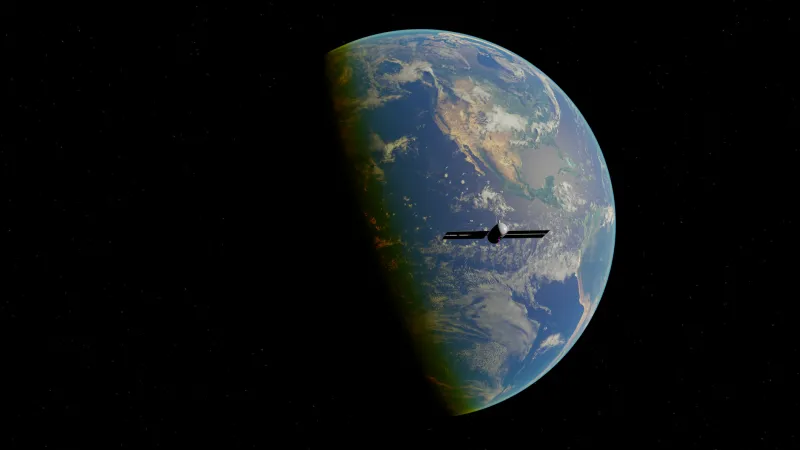
The Invisible Minefield Above Our Heads
Most people picture space as this vast, empty expanse — a clean black canvas dotted with stars. The reality, at least in the orbital neighborhoods closest to Earth, is a lot messier. We're talking about defunct satellites, spent rocket stages, stray bolts, paint flecks, and fragments from past collisions all zipping around at speeds approaching 17,500 miles per hour. At that velocity, even a marble-sized chunk of metal hits with the energy of a small grenade.
This isn't some distant, theoretical problem. It's happening right now, and aerospace engineers who've spent careers thinking about this stuff are increasingly worried that we're approaching a tipping point.
"The debris environment in low Earth orbit is already self-sustaining in some altitude bands," says Dr. Moriba Jah, an astrodynamicist at the University of Texas at Austin who has become one of the most vocal advocates for space sustainability. "We've already crossed certain thresholds where even if we launched nothing new, the debris population would continue to grow through collisions alone."
That's a sobering sentence to sit with.
How We Got Here
The junk problem didn't happen overnight. It's been accumulating since Sputnik went up in 1957. Every rocket launch leaves something behind. Every satellite that reaches the end of its operational life becomes a potential hazard. And every collision — even a minor one — creates hundreds of new fragments, each capable of triggering further collisions.
The scenario has a name: the Kessler Syndrome, first described by NASA scientist Donald Kessler back in 1978. His model predicted that once debris density in certain orbital shells reached a critical threshold, a cascade of collisions would become self-perpetuating. Some researchers argue we've already hit that point in certain altitude bands around 900 to 1,000 kilometers up.
The 2009 collision between an Iridium communications satellite and a defunct Russian Cosmos satellite is probably the most dramatic real-world example of how quickly things can escalate. That single event produced more than 2,000 trackable fragments. The 2021 Russian anti-satellite missile test, which destroyed the Cosmos 1408 satellite, generated over 1,500 trackable pieces and forced the International Space Station crew to shelter in their Soyuz capsule — multiple times.
Right now, agencies like NASA and the U.S. Space Surveillance Network track objects larger than roughly 4 inches in low Earth orbit. But estimates suggest there are somewhere between 500,000 and one million fragments between 0.4 and 4 inches in size — too small to track, too large to ignore.
The Stakes Are Higher Than You Think
Here's where it gets existential. The satellites we depend on for GPS navigation, weather forecasting, financial transactions, and military communications all operate in orbital zones that are increasingly cluttered. A cascading debris event wouldn't just be a setback for space exploration — it could meaningfully disrupt life on the ground for millions of Americans.
And the timing couldn't be worse. We're in the middle of a commercial space explosion. SpaceX's Starlink constellation already has more than 5,500 operational satellites in orbit. Amazon's Project Kuiper is gearing up for mass deployment. OneWeb, Telesat, and a dozen other companies are queuing up their own mega-constellations. The orbital highways are getting crowded fast.
For deep space ambitions — the Moon, Mars, the asteroid belt — a severely degraded low Earth orbit environment doesn't just complicate things. It could delay crewed missions for decades. Every launch vehicle has to pass through LEO. If that zone becomes too hazardous to transit safely, the whole architecture of human space exploration gets bottlenecked right at the starting line.
The Cleanup Crews Are Coming
The good news is that the problem has finally captured serious attention, and some genuinely creative solutions are moving from the drawing board toward actual hardware.
Harpoon and net systems are among the more dramatic approaches. The European Space Agency's ClearSpace-1 mission, currently scheduled to launch in 2026, will attempt to capture a defunct Vespa rocket adapter using a claw-like mechanism. It's essentially a robotic garbage truck in orbit. RemoveDEBRIS, a project out of the University of Surrey, already demonstrated a harpoon capture system in 2019 — successfully skewering a target panel in orbit.
Laser brooms take a different approach. Ground-based or space-based laser systems can nudge small debris particles by heating one side of them, creating a tiny thrust that gradually alters their trajectory and forces them to reenter the atmosphere. It sounds like science fiction, but the physics are solid and several research teams in the U.S. and Japan are actively developing the technology.
Drag augmentation devices — essentially deployable sails or inflatable structures attached to satellites — can significantly speed up the natural orbital decay process, pulling defunct hardware out of orbit in years rather than decades.
There's also growing momentum around policy and international coordination. The FCC has tightened its deorbit rules for U.S. operators, now requiring satellites in LEO to deorbit within five years of end-of-life rather than the previous 25-year standard. It's a step in the right direction, though enforcement across international operators remains a genuine challenge.
The Clock Is Ticking
The uncomfortable truth is that orbital debris is one of those problems where the cost of inaction compounds over time. Every year we wait, the debris population grows, cleanup becomes more technically complex, and the risk of a cascade event increases. The window for relatively affordable, manageable solutions is open now — but it won't stay open indefinitely.
For a generation that's grown up dreaming about Mars colonies and interstellar probes, the idea that a bunch of old rocket parts could derail the whole enterprise feels almost absurdly anticlimactic. But that's the reality staring us down. The big spaceship humanity wants to build for deep space exploration needs a clean runway to launch from.
Right now, we're still cluttering that runway. The question is whether we'll clean it up before we lose the option entirely.